
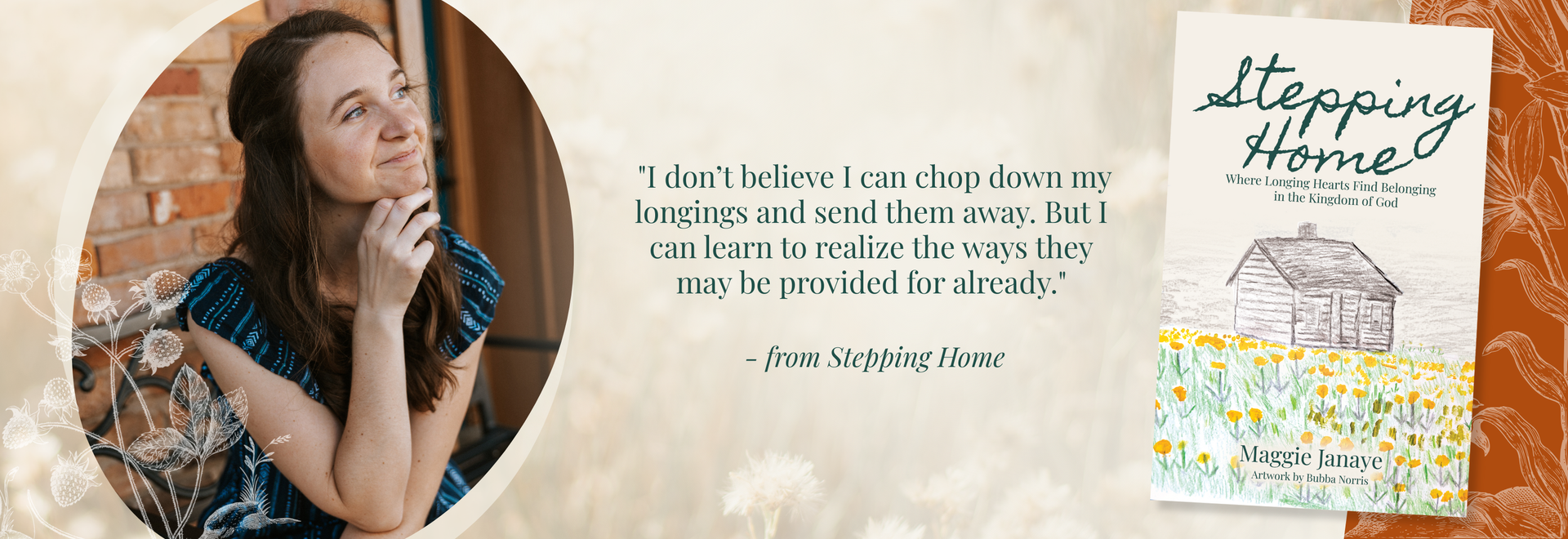
Our longings are made for beauty.
Would you like heathy, actionable ideas for engaging desire today?
Download this guide for twelve healing ways to put desire to action. I'll explore these ideas more each month.
Seven years ago at the beginning of December, we put a big red bow on the top of our Christmas tree. A few days later, my kindergartener came home from school and looked up at that bow for a while. Then she found some paper and markers and set to work at the table. With her little hands, she earnestly squiggled out her best representation of a star, and colored it yellow before she found the scissors to cut around it. She poked a hole in the top point and strung her star onto a blue pipe cleaner. When finished, Amayah held it out to me and said, “Mommy, you can use it for the tree. We need a star.” So, I removed the red bow from our tree and used the pipe cleaner to tie the star in place. The top of the tree curved in a point, and there hung our paper star. Amayah knew what she needed to see on top of the Christmas tree, and she couldn’t ignore it. The memory of her paper handiwork is a great reminder to me that good gifts are not elusive. I’m directionally challenged. The week after Amayah made her star, I set out for Mount Vernon. Somehow I got turned around and ended up all the way in Sulphur Springs before I realized my mistake. Minutes after I rerouted, my van ran out of gas. At my own fault, I'd become stuck on the road nearly an hour from home. As someone who’s lost my way often, the star of Christmas is beautiful to me. To show the way to Jesus, God put a star in the sky—like an arrow pointing the way. The simple need was to follow. God’s way of giving directions is comforting when you’re not only directionally challenged on the road, but in your heart too. Amayah’s paper offering reminded me that even as we’re given the gift of God in human skin, we’re also loved by a God who never stops lighting the way to find His good Gift. A God who is faithful to light the way is just the kind of care my heart needs. A voice in my head fights to confuse my sense of direction. When I want to give and receive love, memories play scenes of shame. I become a little girl presenting a bunch of dandelions picked from the grass…while my gift is dismissed and tossed away. When shame speaks through my memory, it drives me away from love. Even still, there is ever-present longing tucked away in the echoes of the past. Those tender yearnings point toward a journey—to find the place where I feel safe to let my inner child exhale. Like Amayah offered her star, we all have a child inside with intuitive gifts to share. When a child gives a gift, they stretch out the fragile shoots of their growing love, unhindered by decades of disappointments. A child’s gift can touch your heart and draw you to the days when life felt so young and new—a blank canvas that couldn’t wait to see the beauty it became. Love is the star that is always a learning, growing, testing dare to let the heart be a child one more time. Remember the child you need. And there is One who made Himself into a child-gift in the most complete way. He comes as a baby and offers Himself as a gift to the child in me. He came as a gift wrapped inside a womb, and Joseph’s first thought was to quietly disown the mother who encased him. Through the bloody entry of a woman’s birthing body, Jesus gave the tender gift of Himself. His offering given with wide-open love was met by King Herod’s order of mass slaughter, a hope to put the new child to death. The Child of Christmas gave the most vulnerable gift, becoming a child for the lost child heart. He offered love His whole life long, until He was crushed. He steps into a world of wounded hearts…and he becomes wounded beyond recognition in a world where we know this language. Who doesn’t know the wounding of love? Who never longs to feel whole again? He welcomes the wounds. He stays for the crushing. To the death, He never falters, never ceases to come as a child holding out His gift still. There is nothing like a gift from a child. A gift from a child can warm the coldest part of my heart. And only the touch from a baby’s hand can reach for me with enough tenderness to draw me from my fearful sense of direction toward the light of Love. I need a gift only a child could give. And with Christmas, as always, it’s what I’m given. The sovereign Author of Christmas remembers the child in me. When I’m too discouraged to hold out dandelions or make paper stars, He stoops down to speak a language my heart can hear. Here is a King who becomes a tiny gift. He is determined to light up my soul with childlike purpose. There are good gifts to bring. Jesus delights in gifts of frankincense and myrrh and also the gift of a manger and the lullaby’s of animals. Why does He receive the gifts of those who can give only what He’s provided? Because He is a King who treasures the beauty of a gift from a child. For broken hearts, there are tiny fingers who can touch fallow ground and make room for the tender shoots of love to grow again. Where there is room for the child, the child makes room for love. When we are lost and turned around, He lights the way. Do you long for a gift from a Child? Like a star, this longing too, is His gift. Follow the star. The Lord has come. “When they saw the star, they rejoiced exceedingly with great joy. And going into the house, they saw the child with Mary his mother, and they fell down and worshiped him. Then, opening their treasures, they offered him gifts...” (Matt. 2:10-11).
Do many people have a specific emotion they feel the most awkward with? Mine is anger. In some ways, I’d rather meet any other feeling. When my worst memories play across my mind, anger appears as the villain, the direct enemy of love. Whether the anger is from others, or from me, the narrative says that anger destroys. It equates with shame and loss. The rise of this emotion can begin to feel like a threat. Don’t let your anger out, or else. There’s validity to my concerns. Out-of-control anger can hurt people deeply. It can damage and destroy and tear down connections we don’t actually want to tear down. The idea of anger makes me angry. Anger can cause typhoons of damage and sometimes I want to scream about it to the world. Sometimes when I start to feel angry, shame creeps in for the fact that I feel angry at all. On the other hand, part of me knows anger has important roles to play somewhere. It can let us know when something isn’t right. There are times to listen. So, at times, I’ll start to share my anger with someone. Often, I feel clumsy—caught in a world that’s too shaky and uncertain. Anger is a territory full of memories where abandonment happens, people are shamed and nothing is steady. So when I showed up for counseling a couple weeks ago and Chris, my counselor, asked me to consider good things about anger, I didn’t love the topic. But I know her question is valid. In the first several years of marriage, I tried hard to be as low-need as possible. I wanted to be a selfless wife, but I often thought that meant not having needs. The more I contained my needs, the more I felt disconnected from Nano. Anger would find ways to come out of me—it just didn’t look like anger and it always came out sideways. Now, Nano has seen more of my anger than anyone else combined. The more I search for healthier ways to listen to my anger and express my need—and the more we work through those moments—the more I feel connected to him. Marriage is the biggest place where I’ve seen good things come from learning to work with my anger. I’ve also seen hard things come when anger is ignored. How many of us know what it feels like to have a friend avoid us? Then, a long while later sometimes the truth comes out and we find out why. At times, I’ve longed to see a friends’ anger, because I wanted to know that our friendship mattered. In those situations, I’ve felt heartbroken by the silence. The unspoken needs. My own struggles with anger help me understand this better. Often, when I feel anger, something about that feeling is helping me know about a need that I may be struggling to recognize. That’s when fear strikes. I remember the times when I’ve tried to assert myself and lost control. I remember too, the times when my assertion was not received well, connections were damaged, and it felt difficult to know if it was worth it or not. The fear that I feel from those memories is real. Yet, when fear scares me away from navigating my anger, I get stuck in a place where I’m not moving forward. Sometimes we’ve had little experience with seeing positive things come when we assert ourselves. Understandably, this can make us feel cautious about being assertive at all. At times, taking a risk to be assertive in the healthiest way I can find takes all of the emotional energy I can muster. Don’t we all have a point at which the need for assertiveness in a situation drains too much energy and goes beyond what we can manage? Maybe we all have a different level of capacity for that. I have a greater capacity for assertiveness than I used to, though I have lots farther to grow. Often, the person on the other end of the situation is trying to grow their capacity for connection in their own way as well. In some ways, my greatest need may be in learning to be assertive with myself—telling myself what I can do to care for the hurt I feel. There is beauty in the desire to imagine what might be possible when the most unpracticed parts of me find ways to come alive. Somewhere inside, anger wants something good. Peace. Dignity. Better ways to connect. Anger longs to be seen for the goodness she’s after. I want to hear the good things anger has to say—the anger in me, the anger in others. In the movie, Because of Winn Dixie , there’s a nighttime scene where ten-year-old Opal and her father are searching for her missing dog, her best friend. When her dad says it’s time to return home, Opal lashes out at him, accusing him of giving up. In that moment, her deep-seated hurt overflows and she accuses him of giving up on her mother too—being the one at fault for the fact that her mother abandoned her. Rather than lash back at her, her father hears the pain inside her anger. He recognizes her need for safety and connection and he responds in love. That scene always draws my longing and stirs my questions. It leaves me searching to know what I feel invited toward. Don’t we all want to know that we can be seen in our wild anger and still be held in love? But mostly, when we rashly spill anger on people, it leads to less connection, not more. It hurts others, and it hurts us too. So I don’t think it’s correct to name this as what I want to do. It’s been more than two years since the last time I watched that movie with my kids. I still remember how I couldn’t place my finger on what that scene made me yearn for. While Chris spoke with me the other day, she didn’t say anything about that movie, but she brought me to that same place. The same set of questions. She gave the invitation. Feel your anger in the safety of the One whose love is strong enough for all of it. Let yourself be seen by your heavenly Father in your rage. He never fails to see the good longings within your anger and to wrap you in His love. I know what the scene in Winn-Dixie made me want—a place where my anger can co-exist with love. When anger and love find ways to join hands, miracles happen and love is multiplied. May imagination open wide to the good things that can come when we feel our deep anger in the presence of Love. When I remember I am safe to navigate anger, the security of love can guide me in what’s needed.
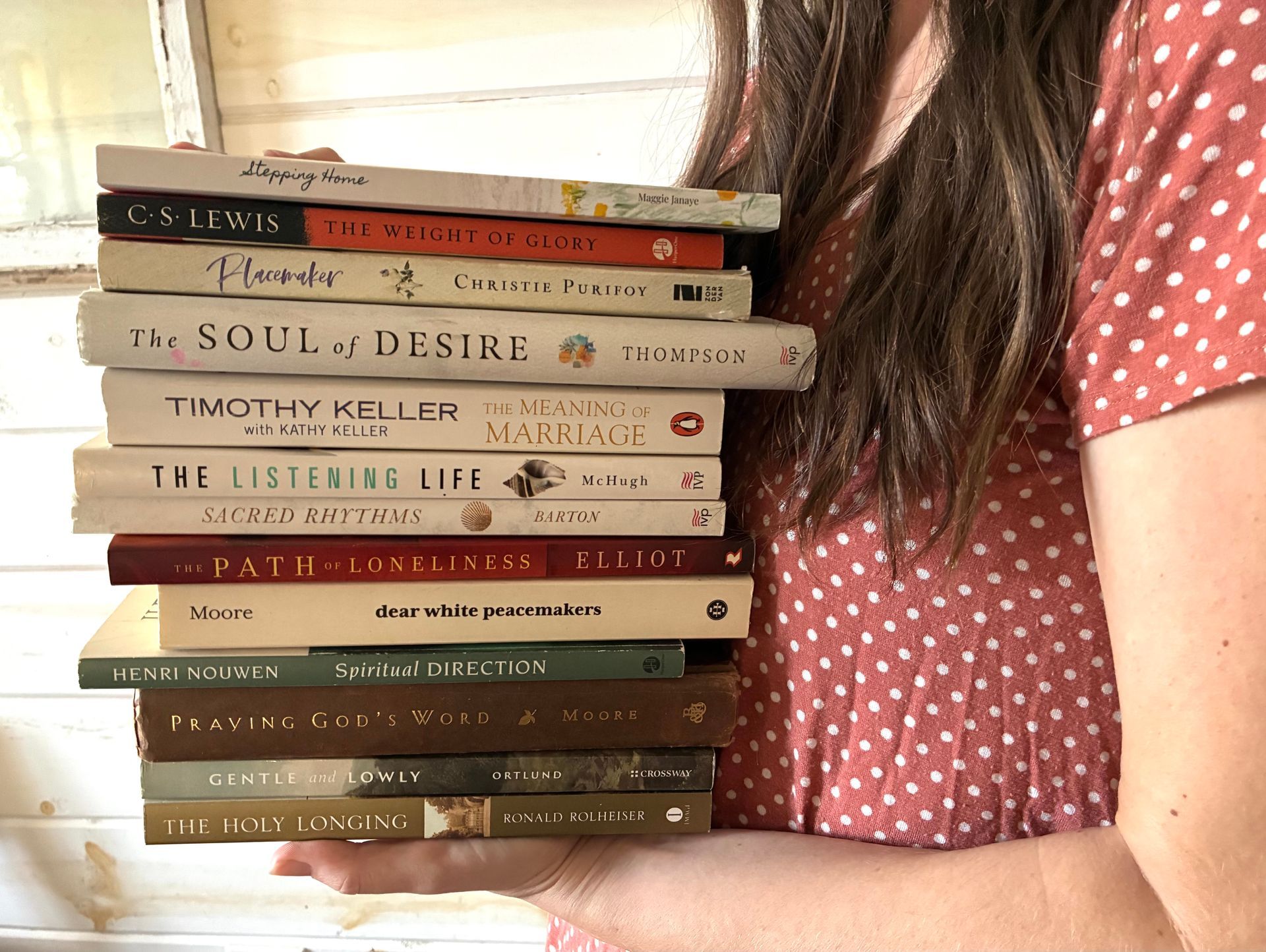
“Art can be seen as not hostile to faith, but as practice for it. Building the muscle of imagination makes us better fit to believe. And love, the central command of faith, requires enormous imagination, to understand the life, feelings, or needs of someone else” -Carey Wallace It’s because I’ve been deeply affected by good books that I enjoy making art on pages too. When we write, we engage imagination. When we read, we open to the experience of letting another soul’s imagination stir our own. Books are the most patient teachers. They never demand to be read. If you’ve had your fill for the day, they are content to rest in the corner for however long you need—whether a day, or a month. In a book, I step inside another’s mind, made available for me to enjoy or consider. But I can leave anytime I need to. I’m grateful for many people who chose to put their thoughts on paper, knowing they leave their readers with this gift. During the release of Stepping Home, I want to share some books I’ve been taught by—teachers I drew from while I wrote my book about belonging. I’ll share them in the order they appear in the endnotes of Stepping Home. The Weight of Glory and Other Addresses by C. S. Lewis To be honest, I’ve only read one of the other addresses, but “The Weight of Glory” is a must-read for any seeking soul. While originally shared as a sermon, it would never do for this to not be available in writing. I received this book as a birthday gift several years ago and savored every word of this sermon. Lewis puts language to desire in a way that soothes my fears, awakens my yearnings, clarifies my wants, and leaves me feeling free to let my heart come alive. Placemaker by Christie Purifoy I learned about Christie from an author I follow. Christie writes about trees and homes almost like they’re full of dreams—as if they are always open for us to help them bear a reflection of our perfect, eternal home. She leads her reader to see the physical places we share as tender invitations into the art of partnering with our Creator. Her love for magnolias and maples, and her soul-deep ache to tend well to the places that shelter her people, made me see life in our farmhouse home with new eyes. The Soul of Desire by Curt Thompson, MD I heard Curt Thompson interviewed on a podcast and needed to read his book. I read The Soul of Desire right after one of my biggest personal failures. It stirred my imagination for a hopeful future. Thompson explores the science behind our yearning humanity and our need for connection, and he considers it from a perspective of faith as well. His book gave me both scientific and biblical reasons to see my ever-searching heart, not as defective, but as beautifully made and capable of coming to trust and believe in the goodness God has in store. The Meaning of Marriage by Timothy Keller with Kathy Keller Nano and I did this study with a church small group. It’s a grounding, relatable guide that validates the human longing for companionship and takes great care in addressing the obstacles of attachment and commitment. What gave it the most value to me is how it stayed in tune with the desires of the reader and acknowledged our humanity with frankness. Marital conflict and sexual struggles were handled with candor and grace. It prompted good self-reflection. And it did a beautiful job of connecting the needs of marriage, in all aspects, with the work of Christ—both in laying Himself down for His bride, the church, and in submitting Himself to the Father. The Listening Life by Adam S. McHugh This is also a book I learned about from an author I follow. I’ve never read a better book about listening. Every time I read it, I remember how healing it feels to be listened to, and how powerful a gift we share when we choose to listen intentionally. McHugh walks his reader through the art of living life with a posture that holds space—to hear what lies beneath the surface of our lives and those around us. Whenever I return to McHugh’s words, I feel exposed in my need to listen, and also gently led to a richer place. Ideally, I’d like to read this book at least once a year to help myself remember. Sacred Rhythms by Ruth Haley Barton I read this as part of a course I took on contemplative spirituality. In a noisy world, Barton invites her reader to slow down on the inside and embrace rhythms of solitude and stillness. She helped me learn beautiful ways to savor and experience Scripture when I need a break from diagrams and intellectualism. She connects deeply with desire, encouraging her reader to know that the longing for more is valid and worth our deep attention. The Path of Loneliness by Elisabeth Elliot The summer after I turned eighteen, I ran across this book for sale at an event. The title drew me in because I felt deeply alone. I’ve read a few of Elisabeth Elliot’s books and this is my very favorite. While not every page resonates with me, this book as a whole reaches me at my core every time I read it. It comforts me, convicts me and leads me to embrace the gifts that lie along the path of lonely places. While a good bit of what she writes comes from her two experiences of being widowed, Elliot’s words are deeply applicable to any kind of lonely season. Dear White Peacemakers by Osheta Moore Osheta wrote this after George Floyd’s death, and lovingly addressed it to her white brothers and sisters in Christ. In a way, she speaks to Christians who want to help bring us away from racism as a culture, but would like to know more about what it feels like to be in someone else’s shoes. I ran across her book online and wanted to learn from her perspective. She dives deep into the art of balancing grit and grace in the desire for peace. I find so much in her words that helps me consider more deeply, from a biblical perspective, what it means to listen, to repent, to take accountability and to embrace ways that make for peace. Spiritual Direction by Henri Nouwen This was originally a discourse Nouwen shared that was turned into a book after his lifetime—by one of his students, and by his editor. I came across it at a bookstore. I found it to be deeply refreshing in helping me hold space to listen to the voice of the Spirit of God. Nouwen addresses how we can create better space for this in our hearts, in Scripture, and in church community. While reading, I felt encouraged in my identity in Christ, and challenged to plainly see things I chase after for the wrong reasons. Not every teaching in the book was for me—and as for anything, I’d encourage testing this book through the lens of Scripture. Praying God’s Word by Beth Moore In Stepping Home , I share the story of how I stumbled upon an old stained copy of this book on the day I turned 29. The next morning Beth’s words had me in tears. In a kind way, she helped me to be pricked by Scripture, which prepared my heart to be faced a few days later with a difficult truth from a sermon that I needed to hear. This book is a helpful guide to using Scripture to pray through various struggles in life—from rejection, to idolatry, to despair. For each specific difficulty, Beth speaks into your heart, then provides words to help you in prayer—prayers she’s written based on specific Scripture. Gentle and Lowly by Dane Ortlund I learned about this book while sitting in church. I found myself so hungry to hear what Scripture shares about the gentle heart of Jesus that when I finished the book, I turned back to the beginning and read the whole book through again. Ortlund shares the profound truth that when Jesus describes his own heart, the two words He chooses are “gentle and lowly.” This book is full of Scriptural assurance for the sinner, the doubter, the one who lives with fear and guilt. It does a thorough job of reaching into the reader’s heart, and carefully showing from Scripture how deeply God’s heart longs to meet His children where they are. The Holy Longing by Ronald Rolheiser While I wouldn’t agree with Rolheiser on many things, I find so much rich truth in his perspective, so much to gain and learn from. Most every time I hear him quoted, his words strike me to my core, and books about longing will always catch my attention. He speaks to our felt sense that our passion and our spirituality are at odds with each other. He invites his reader to consider how our longing, even our sexuality, is interconnected with our spirituality. Rolheiser invites his reader to come to the table of spirituality as a whole person, where our passionate parts can learn to thrive in healthy ways. I haven’t finished reading his book, and again, encourage discernment. Each of these books have met me in deep places. To share about them all stirs my memories and my gratitude for the means God uses to meet us. Perhaps one or two of these are books God has used, or will use, to meet you too. These twelve books all play a role in my own written journey. If you’d like to read a book that combines these ideas, that’s what you’ll find when you read Stepping Home. How do we engage in faith without pretending away the desiring, aching, yearning parts of us? It’s a healthy question to sit with, one that invites authenticity. I don’t promise black and white answers, but I share my favorite ways God has met me in this question. I’m so happy to share about the gift that is open for all—the gift of always having the option to take another step toward Home. "Stepping Home by Maggie Janaye" is available now through Amazon and other retailers.